
Is this really how we keep kids safe?
Apr 28, 2026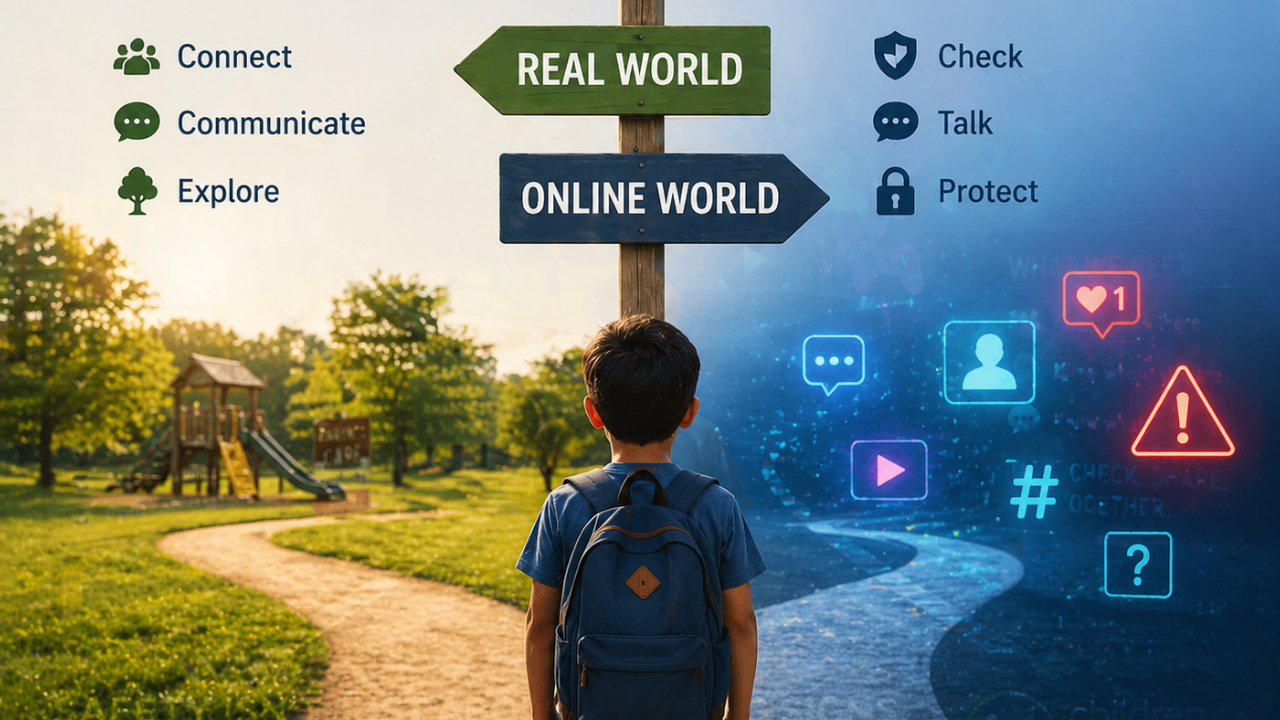
We spent decades making real-world playgrounds safer, rubber flooring, better equipment, and community education.
Online? We’re suing Big Tech for making the “playground” look fun… and calling it child protection.
What everyone says; “Dangerous” play equipment and areas in the local city park have over the last few decades been slowly eradicated, we keep kids safe this way.
But heres a new take on the question: Would it be okay if we just had signs saying “danger” at the top and bottom of every piece of equipment, would this keep kids safe too?
What have we done and what should we do
What we promise is child protection, what I show you here is the reasoning as to why this isn't as it promises, and currently doesn't work. What we need is safer playgrounds and how we can do this, together.
We now have rubber or mulch-based flooring to prevent many of the broken bones and head injuries that incapacitated some children and no doubt led to the deaths of many over the years. We don’t allow tree climbing and, in some parks, there’s no boating on the lakes anymore. Gone, vamoose. Not here in this park!!
Why removing access and using signs doesn’t work. Read on to find out what we need to do to change online safe-ness for kids.
One of the pushes of getting children back into the ‘real world’ and away from screens so they can ‘risk take’ is now being suggested to be these very broken bones as a measurement of ‘success’ against the big tech giants. More broken bones through outside play championed as a way for adults to brag that they allow their children to free roam, make mistakes and not be one of those sedentary, obese and incumbent tech kids. Almost a ‘look how many times my kid got injured’ as the new comparison to ‘those’ lazy, indoor and screen based kids.
[side note; if these “risk taking” broken bones or head injuries lead to a child’s death will the adult proponent of this approach be held accountable as big tech are?… I don’t think so; but hey call me cynical about this]
Why did we make the real world safer?
Well, over many years when jagged edges on equipment resulted in life changing or threatening injuries local councils were held accountable and so the world developed health and safety laws to ensure the playground equipment would not contribute to injury or death of any person using it. IF of course it could be shown the kids used the equipment “safely” and “properly” which is certainly the way of litigation in the courts. One side arguing that they are not accountable for how ‘users’ use the equipment or the spaces. And I suspect this sounds familiar.
Health and safety or community education and accountability?
Yet, we (society) still found ourselves creating safer environments for the kids to play in and we made sure that we popped up signs telling folk not to let their dogs in the pond, not to feed the birds and not to fall down holes, just to make sure that we covered all bases. And we also knew of the dangers of people in those environments [more on this in a moment] and so we created media based safety campaigns and even a worldwide hit (from the Prodigy) reiterating to us the advice; ‘Charley Says!.
Our society created a level of knowledge that helped parents help children, allowed for the use of the city park and its said we all knew our roles (in where the finger could be pointed should a kid ‘talk to a stranger’, ‘ride down a slide on a BMX’ or get thumped/clipped/smacked when being ‘cheeky’). Parents and kids might be accountable or the local council depending upon the issue and or injuries sustained.
And, in the midst of this education and prevention children were sadly hurt, went missing, were kidnapped, drowned, got jumped, assaulted and in some cases died. This was not okay and so we made our parks and city centres safer by many means and we all took part in the education of the community.
This is now being called overprotection in some cases. And so, Let me refer you back to the point about children breaking bones, getting life altering injuries or dying, it is not okay to poo-poo the process of creating safer environments at the expense of saying ‘compared to this new environment’.
Why? Because regardless of signs, education and people even shouting at kids not to do dangerous things, some still did them. Its part of the risk-taking profile of a maturing child and their brain architecture. Hyper rational thinking to children saying they were ‘not thinking’ and of course having a whale of a time and not understanding some of the risks.
Signs alone don’t work.
Children need repetition, age led reasoning they can understand and a requirement of the community education to support not shame, provide mechanisms of the Jimmney Cricket ‘superego’ and emotional regulation.
And that’s in the real world, as well as online.
What we gained by suing in the way that occurred recently
This community education foundational approach is the same one that ought to have been used when allowing children online. Sadly the playground they enter into have little to no signs, but also they have not utilised the same community-based approach that we have in the real world.
We have an education approach that has significantly targeted children and has been haphazard and uncoordinated overall, we have terrified parents rather than supporting them and of course we point to the larger corporations and organisations like government to now protect our children. They will and are responding with the removal of the playgrounds, whilst not understanding fully where those playgrounds are or how to make them safer overall.
The suing of some of the big tech giants recently occurred in California and this is likely now is the start of a trickle downstream of similar cases. However, what occurred was seemingly a process of “you made the playground look enticing rather than safe”. And so the tech companies may now start putting up signs.
But only signs.
They are not making the playground safer, they are not installing rubber and mulch flooring, they are now in a position that has been forced of their only real requirement to ‘put up danger signs’, to admit in public that the use of the equipment can result in the equivalent of injury or death.
Its not quite the same thing is it when it comes to safety of children.
What we needed to do but haven’t yet?
What I mean by this, and I have been musing over this for a while is we haven’t resulted in making the environment safer, protecting children from criminals and people who want to utilise children for their own s*xual gratification. Nope.
We set a precedent that the suggestions about the park and what it can deliver in terms of fun and laughter and the resulting injuries or death from use’ is more important to regulate. Or more succinctly put; the ‘warning signs’ were not placed in full view of children or explained to them. And even if they were?
Who needs the warnings, who needs the guidance and education?
All of us, because I was once the person who focused on the tech and the solutions therein. It was a mistake, one that cost me many years of repetition and no cybertrauma support for the kids whom I was supporting in schools, sports clubs and youth settings. I was teaching people the what not the why. I kept repeating the same online safety messages without helping the professionals understand the part I understood in therapeutic setting and through writing my books and research. Its the system being taught to date by many others and its not the one that makes the change at the level it needs to.
In my work clinically, consulting and being in settings such as education, social care, residential homes, with looked after children, police settings and in legal cases (courts), it has helped me create the system of 'how' to do this through child developmental and trauma informed processes, policies and protocols within a safeguarding lens.
You need more than what, when and where, you need why and what that means for the development of a child for the rest of their life. We need a system that helps you understand; People AND places online.
What are the warning signs (and conversations and education) that are needed? Well this is where we need talk about the kinds of environments AND people. You see most parents and adults use the technology but have been told it’s a product and so have negated their own use of the playground to see it AS a product when its an environment
For that, the education needs to be held in the same way we do the local park, city centre, sports club and other spaces we go into. Yes the shops, the merchandise and equipment are important but so are the people who also go into those spaces.
If you are staff, professionals or care for a child through your employment role then the following may help you have a conversation with a child that are steeped in my framework. This is not a sales pitch but some guidance and ideas to get conversations started.
Here are three top tips about online environments and how we need to think about this joined up education.
- Who goes there? Talk to people about people.
Ask how you know who someone is and how to check this; - When you are using the tool (the phone for example) where are you?
Is there an adult you can talk to about what is going on ‘in there’ because sometimes this adult can help you work out tip number 1; - Guidance about the equipment is as important as 1 and 2, so we need to talk about the kind of ‘stuff’ you might see, hear or be sent. How can you talk to me about it if I don’t talk to you about it either?.
Signs aren't safety. Conversations are.
If you want to know how to talk to a child about who they meet, where they are, and what they see online drop me a follow and share this blog and lets start to do this together. Let me know how you get on with these conversation starters, because thats often how we begin these safety talks.
Warmly,
Cath